Seasonal Marketing Campaigns: A Data Driven Framework for Retail Growth
Seasonal marketing campaigns drive major retail revenue, but success depends on data, personalization, and timing. Brands that use predictive insights and targeted strategies outperform generic campaigns and achieve higher conversions and long-term growth.
Apr 1, 2026
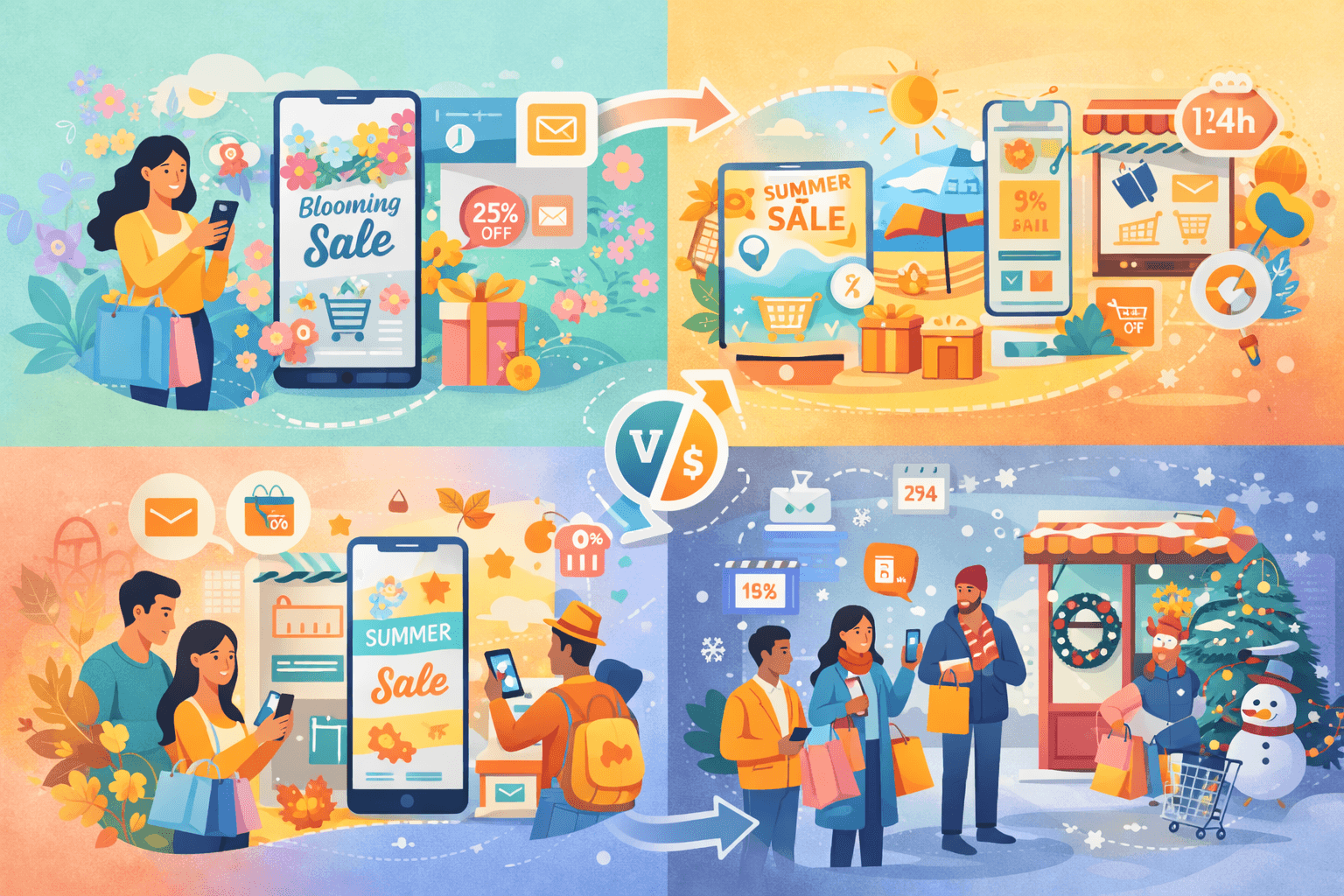
Holiday and Seasonal marketing campaigns are among the biggest growth opportunities in retail, yet most brands struggle to fully capitalize on them. While peak periods like Black Friday and Cyber Monday, back-to-school, and Valentine's Day drive massive spikes in demand, predicting customer behavior and aligning campaigns effectively remains a challenge.
While many brands rush to launch last-minute campaigns, high-performing retailers plan and build data-driven strategies that anticipate seasonal demand. Each season brings distinct emotional and behavioral shifts, and brands that understand these patterns create more relevant, high-impact campaigns.
In this guide, we break down how retailers can identify high-impact moments, design smarter seasonal marketing strategies, and execute campaigns that drive measurable revenue growth and long-term customer value.
High Impact Seasonal Moments That Drive Retail Revenue
Studies show that the 2025 holiday season crossed $1 trillion in US retail sales for the first time. These numbers confirm what every retail marketer already knows: the seasonal calendar is where the majority of annual revenue is made or lost.
Key Seasonal Events with Peak Purchase Intent
The U.S. retail calendar is anchored by high-intent windows like Thanksgiving, Black Friday, Cyber Monday, and Christmas, contributing ~13.5% of annual revenue. Beyond this, moments like back-to-school (~$40 billion in 2025) are actively utilized by forward-looking retailers.
How Customer Behavior Shifts Across Seasonal Moments
Seasonal marketing campaigns are not just about what customers buy, but they are about how their behavior changes leading into and during a peak window. Nearly 45% of U.S. consumers start holiday shopping before November. During Cyber Week, search, comparison, and cart abandonment all spike simultaneously. This makes single-touch campaigns ineffective. High-performing brands build multi-touch journeys that engage customers throughout the decision window. Understanding these transitions is essential for building effective seasonal marketing ideas that align with real customer intent.
Why Timing Alone Fails Without Customer Level Personalization
The most common seasonal marketing mistake is treating campaigns as a timing exercise, sending the right offer at the right calendar moment. But timing without personalization is just noise. 81% of customers now prefer companies that offer personalized experiences, and 65% of consumers say they are more likely to stay loyal to a brand that personalizes their interactions. Personalized journeys are built on unified customer data, behavioral triggers, and dynamic segment logic, which convert seasonal intent into realized, margin-positive revenue.
Why Seasonal Marketing Campaigns Drive Disproportionate Revenue
Seasonal events don’t just increase revenue. They concentrate it into high-intent, short-duration windows. For retailers, the gap between reacting and planning often defines margin erosion versus profitable growth.
1. Concentrated Demand Windows Create Revenue Spikes
Seasonal periods compress demand into narrow windows where customers are already searching, deciding faster, and responding to urgency. This leads to higher traffic and conversion rates. Retailers with strong planning capture significant revenue quickly, while others rely on discounting, reducing profitability during peak periods.
For context, 197 million consumers shopped during Cyber Week 2024, about 59% of the U.S. population, creating unmatched demand intensity.
2. Seasonal Campaigns as Customer Acquisition and Retention Levers
Seasonal shopping drives multi-item purchases and cross-category exploration. Critically, 61% of shoppers are open to trying new retailers, making this a prime acquisition window. With targeted recommendations and upsell strategies, retailers can grow basket size and frequency without deep discounting.
Even small retention gains matter. A 5 percent increase in retention can drive over 25% profit growth, making seasonal marketing campaigns key to long-term customer lifetime value.
3. Opportunity to Increase Average Order Value and Purchase Frequency
Personalization in retail plays a decisive role in maximizing seasonal revenue. Sessions with product recommendations can deliver up to 369% higher average order value, while personalized experiences can generate 11x more revenue per visitor. Retailers can use purchase history and behavior signals during peak events to drive cross-category discovery and increase basket size without eroding margins through discounts.
Why Most Seasonal Campaigns Fail at Scale
Seasonal marketing campaigns fail at scale due to rushed planning, rigid strategies, and poor execution. As budgets grow, inefficiencies in targeting, creative, and operations amplify, leading to wasted spend and declining conversion performance.
1. Calendar Driven Planning Instead of Data-Driven Execution
Most campaign calendars are built top-down, focusing on key dates and budgets while ignoring actual customer behavior. Yet 55% of consumers purchase during early promotions, before peak events. Brands activating only on event day miss high-value buyers. Effective execution uses behavioral signals, not fixed calendars.
2. Margin Erosion Due to Blanket Discounting
Blanket discounting during seasonal marketing campaigns often leads to margin erosion, as retailers compete aggressively on price rather than value. This approach trains customers to delay purchases until discounts appear, weakening full-price sales. In contrast, targeted, personalized promotions help protect margins while driving more meaningful and sustainable revenue growth.
3. Lack of Real Time Campaign Optimization
Most seasonal campaign ideas are planned in advance, launched, and reviewed only after completion, leaving performance untapped. Underperforming segments, channels, or promotions can be adjusted in real time. The difference between good and exceptional campaigns lies in optimizing in-flight using strong analytics and agile execution.
4. Fragmented Customer Data Across Channels
Many retailers operate with siloed customer data, with e-commerce, in-store transactions, and loyalty data stored separately. When campaigns rely on incomplete profiles, segmentation weakens and personalization suffers. A customer who shops in-store and later browses online signals clear intent, but only if these interactions are connected into a unified customer view.
5. No Connection to Customer Lifetime Value (CLV)
Most seasonal marketing campaigns focus on short-term metrics like revenue and conversion rates, overlooking long-term value. Campaigns optimized for customer lifetime value drive more sustainable growth. Acquiring fewer high-intent customers who return repeatedly is far more valuable than large volumes of one-time buyers.
The Modern Approach to Seasonal Marketing Campaigns
Modern seasonal marketing campaigns go beyond traditional promotions by using data, personalization, and real-time trends to connect with audiences more effectively. Here are some of the key strategies that define this modern approach.
1. Behavioral Triggers Instead of Generic Promotions
Modern retail seasonal marketing strategy replaces fixed promotional schedules with behavioral triggers. Instead of sending a Black Friday email to your entire list on November 1, you trigger campaigns based on signals like a customer who browses holiday gift guides three times in a week receives a personalized offer; a customer who purchased last Thanksgiving but has not visited since October receives a re-engagement campaign timed to their historical purchase window.
2. Always-On Campaign Journeys Across the Season
Rather than treating a seasonal event as a single moment, leading retailers build always-on journeys that span the full seasonal window, including a pre-season phase to build awareness and intent, a peak phase to drive conversion, and a post-season phase to extend the relationship and set up the next cycle.
3. Micro-Segmentation for High-Value Customer Cohorts
Instead of broad demographic segmentation, micro-segmentation uses behavioral, transactional, and predictive data to create highly specific customer cohorts, including high-CLV customers showing churn risk heading into the holiday season; lapsed customers with a high reactivation probability for Valentine's Day; and first-time back-to-school buyers with a high probability of a repeat purchase.
The 5 Layer Framework for High-Performing Seasonal Campaigns
High-performing e-commerce seasonal campaigns require more than discounts; they need a structured journey that guides customers from awareness to purchase.
1. Unified Customer Data Foundation (Online + Offline)
High-performing seasonal marketing campaigns start with a unified customer view that combines transactions, interactions, and engagement across all channels. This includes integrating e-commerce, POS, loyalty, and CRM data into a single platform. Without this foundation, campaigns rely on incomplete insights and fail to deliver true personalization and impact.
2. Predictive Intelligence and AI-Led Segmentation
Once unified data is in place, predictive analytics and AI-led segmentation turn it into actionable insights. Retailers using AI-driven strategies see 20–30% higher campaign ROI, while behavior-based personalization can drive up to an 89% increase in purchases. By analyzing past behavior, models can predict which customers are most likely to respond, enabling precise targeting that consistently outperforms rule-based segmentation.
3. Omnichannel Campaign Orchestration (Email, SMS, Push, Social)
Modern consumers do not live on a single channel, and seasonal marketing campaigns cannot afford to either. Effective omnichannel orchestration means coordinating across all of these touchpoints with a consistent message and a single customer view, not running the same campaign independently on five separate platforms.
4. Dynamic Promotion Optimization and Margin Control
Not every customer requires deep discounts to convert during seasonal marketing campaigns. Some respond better to loyalty programs & rewards, exclusive access, or curated bundles. Dynamic promotion optimization uses customer data to deliver the right incentive to each segment, improving conversions while reducing unnecessary discounting and protecting margins.
5. Incrementality-Based Measurement and ROI Tracking
The final step is measuring true impact by focusing on incremental revenue rather than total seasonal sales. This requires structured experimentation, accurate attribution, and CLV-based ROI analysis. Only this approach determines whether a campaign generated real value or simply shifted demand and delayed returns.
Category-Specific Seasonal Campaign Strategies
Effective category-specific seasonal marketing campaigns align product offerings with customer needs and buying intent during key moments.
1. Grocery and Food & Beverage
For grocery and F&B retailers, seasonal campaigns revolve around meal occasions and gifting traditions like Thanksgiving and Christmas. High-performing strategies use personalized meal recommendations, grocery loyalty rewards on key items, and cross-category bundles to increase basket size without heavy discounting.
2. Fashion and Apparel
Fashion seasonal campaigns are high-volume but margin-sensitive, with apparel discounts reaching 25.1% at peak during the 2025 holiday season. To avoid margin erosion, leading retailers focus on pre-season targeting of high-intent browsers and use personalized journeys based on style preferences and purchase behavior, outperforming mass discount-led campaigns in both conversion and full-price sales.
3. Electronics
Electronics is the bellwether category for seasonal campaigns and the most aggressively discounted. Customers researching electronics typically spend weeks browsing before purchase. This makes predictive timing critical, allowing retailers to identify high-intent moments based on behavior and engagement patterns and intervene with relevant, conversion-focused messaging.
4. QSR and Food Delivery
For QSR, seasonal campaigns must match the speed of demand, with events like the Super Bowl driving $14.8 billion in annual spending. High-performing strategies use limited-time offers, event-based loyalty rewards, and geo-targeted messaging to boost both visit frequency and average ticket size.
Advanced Strategies for High-Performance Seasonal Campaigns
Seasonal success depends on precision in timing, targeting, and execution. Retailers that move beyond generic campaigns and adopt data-driven, adaptive strategies consistently achieve stronger conversions, better margin control, and higher customer lifetime value.
1. Predictive Campaign Timing Based on Customer Intent
Rather than activating campaigns on calendar dates alone, leading retailers use predictive intent models to identify each customer's peak receptivity window within the broader seasonal period. Predictive models trained on individual purchase history identify these patterns at scale.
2. Supplier-Funded Promotions to Protect Margins
One of the most underutilized strategies in seasonal retail marketing is supplier-funded promotions. Promotional mechanics where the discount or incentive is partially or fully co-funded by the brand manufacturer rather than absorbed by the retailer.
3. Hyper-Personalized Rewards Instead of Generic Discounts
Replacing blanket discounts with hyper-personalized rewards, including loyalty point multipliers, category-specific bonuses, early access offers, or experiential rewards for high-tier customers, consistently outperforms generic discounting in both retention impact and margin efficiency.
4. Geo-Targeted Campaigns for Store-Level Conversions
For retailers with a physical store network, geo-targeted campaigns that activate based on customer proximity can drive significant incremental footfall during seasonal peaks. Geo-targeted campaigns that bridge digital activation and physical conversion are one of the highest-ROI mechanics available to omnichannel retailers.
5. Real-Time Campaign Switching Based on Performance
The final advanced strategy is in-flight campaign optimization, reading performance signals in real time, and switching mechanics, audiences, or channels based on what the data shows.
Common Mistakes to Avoid in Seasonal Campaigns
Here are some common mistakes that limit the effectiveness of seasonal marketing campaigns and impact both revenue and customer experience.
1. Over-Discounting Without Profitability Control
Committing to deep discounts without understanding customer sensitivity reduces margins unnecessarily. Many customers would convert with lower incentives, making blanket discounting inefficient and costly.
2. One-Size-Fits-All Messaging Across Segments
Loyal customers and first-time buyers require different experiences. For example, a loyal customer who has shopped every Black Friday for four years deserves a fundamentally different experience than a first-time Cyber Monday buyer. Generic messaging reduces relevance and weakens engagement, especially among high-value segments.
3. Lack of Omnichannel Consistency
Inconsistent messaging across email, app, and store creates confusion and erodes trust. Customers expect a seamless experience across all touchpoints.
4. No Real-Time Optimization
Treating campaigns as fixed executions limits performance. Monitoring and adjusting campaigns during the season improves outcomes and prevents wasted spend.
5. No Post-Campaign Data Analysis
Failing to analyze campaign data leads to missed insights. Strong post-campaign evaluation helps refine future strategies and build long-term performance improvements.
Seasonal marketing campaigns are no longer about timing alone but about precision, personalization, and performance. Retailers that combine unified data, predictive insights, and structured execution can convert peak demand into measurable revenue, stronger retention, and long-term customer value, turning every seasonal moment into a sustained growth opportunity.
If you are looking to drive high-performance seasonal campaigns, Loyalytics enables it with unified data, predictive analytics, and personalized customer journeys at scale.
FAQs
What are seasonal marketing campaigns in retail?
Seasonal marketing campaigns are coordinated promotional and engagement initiatives that retailers run during high-intent commercial windows such as Black Friday, Cyber Monday, Valentine's Day, back-to-school, or the winter holiday season.
How do seasonal campaigns differ from regular marketing campaigns?
Seasonal marketing campaigns run in short, high-intent windows and focus on urgency, relevance, and scale. Unlike always-on marketing, they require higher investment, faster execution, and stronger margin control to maximize impact.
How do you identify the most important seasonal events for your business?
Identify key seasonal events by analyzing historical transaction data to find revenue peaks, top-performing categories, and high-value customer segments. This reveals the moments that drive the most impact for your specific business.
How do you build a data-driven seasonal marketing strategy?
Build a data-driven seasonal marketing strategy by unifying customer data, using predictive analytics for targeting and timing, executing personalized omnichannel campaigns, and measuring performance based on incremental impact rather than total revenue.
How can retailers reduce dependency on discounts during seasonal campaigns?
Retailers can reduce discount dependency by using targeted promotions such as loyalty rewards, early access, and bundles. Dynamic discounting ensures only necessary incentives are offered, protecting margins while maintaining strong conversion rates.
What role does customer segmentation play in seasonal marketing?
Customer segmentation makes seasonal marketing campaigns more relevant by using behavioral, transactional, and predictive data to target specific cohorts. This enables personalized journeys that improve engagement, conversion rates, and overall campaign performance compared to mass marketing approaches.
How does AI improve seasonal campaign performance?
AI improves seasonal marketing campaigns by predicting customer intent, optimizing offers at an individual level, enabling real-time adjustments, and forecasting customer lifetime value, resulting in more precise targeting, higher conversions, and better allocation of marketing investment.
What are the most effective channels for seasonal marketing campaigns?
The most effective channels include email for awareness, SMS and push for immediate engagement, and social for reach. Coordinated omnichannel campaigns across these touchpoints consistently outperform single-channel approaches in driving seasonal campaign performance.
How do you measure incremental revenue in seasonal campaigns?
Measure incremental revenue using control groups that do not receive the campaign. Compare their behavior with exposed customers to isolate the true impact, ensuring revenue is driven by the campaign and not shifted from existing demand.
How can seasonal campaigns increase customer lifetime value (CLV)?
Seasonal marketing campaigns increase CLV by converting customers into long-term relationships through onboarding, personalization, and retention strategies. Connecting seasonal efforts to lifecycle marketing ensures sustained engagement and higher long-term revenue from each acquired customer.
Related Blogs

Loyalty Program ROI Calculator: How to Measure the Real Impact of Your Loyalty Strategy
Most brands track loyalty metrics but fail to measure true ROI. A loyalty ROI calculator helps quantify incremental revenue, retention lift, and costs to drive data-driven growth.
Apr 10, 2026

When Loyalty Turns Against You: Understanding and Preventing Program Abuse
Loyalty program fraud hides behind strong engagement metrics, draining revenue through fake enrollments, points abuse, and manipulation. Detecting and preventing it is key to protecting margins, data accuracy, and long-term program growth.
Apr 2, 2026

Why Most Loyalty Programs Fail, and How AI Is Quietly Fixing Them
Most loyalty programs fail due to poor personalization and static execution. AI transforms them into dynamic systems that predict behavior, personalize in real time, and drive measurable retention, engagement, and ROI.
Apr 1, 2026